
Search The Bohemian Brewery Blog

Tuesday, May 24, 2011

We're in the golden age for American Beer


Infographic Of The Day: We're In The Golden Age For American Beer


Beer seems like a fixture of American culture. But it hasn't always been so, as William Bostwick, co-author of Beer Craft, points out.
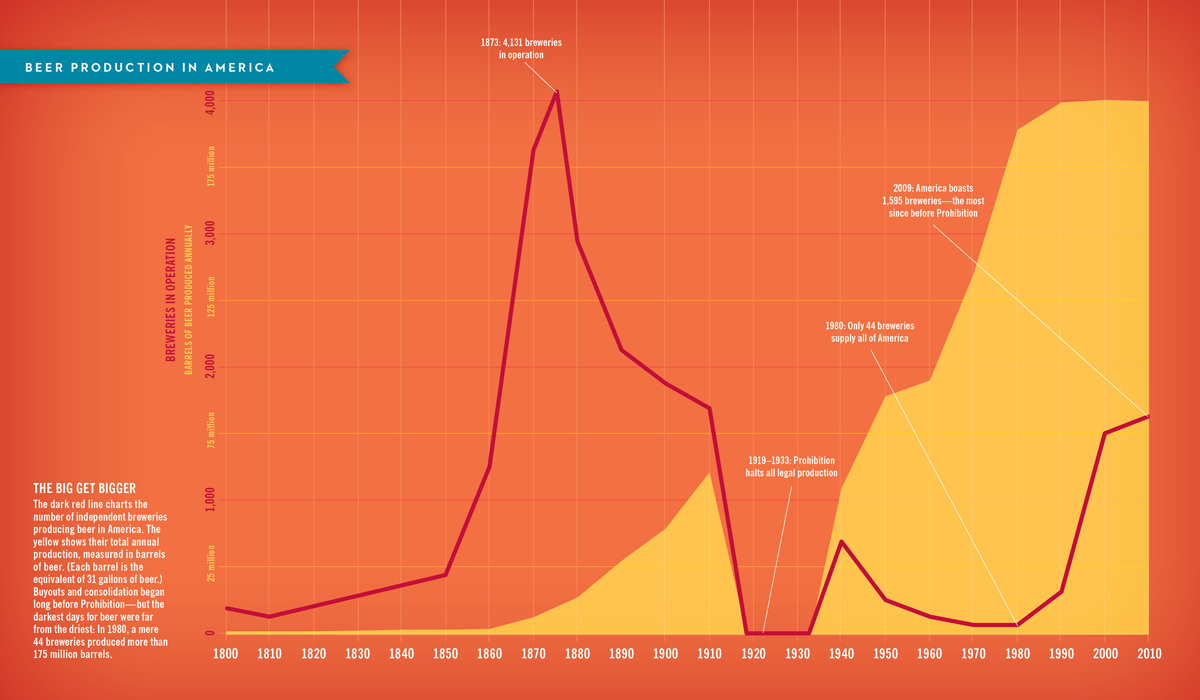
Today's golden age of beer has been a long time coming. We haven't drank this much beer from this many breweries for a hundred years. Sure, most of the 204 million barrels of beer made in America last year came from two monstrous brewing conglomerates--Anheuser-Busch InBev and MillerCoors--but 97% of the breweries in operation are small, independently owned craft breweries. The big are at their biggest, but the underdogs are gaining steam.


[Click to enlarge]
The big are at their biggest, but the underdogs are gaining steam.
This chart, from a guide to beer and homebrewing, Beer Craft, which I wrote with Jessi Rymill, tracks American brewing from its earliest days of pumpkin-and-tree-bark hooch to the sudsy empire of today. American brewing began in the kitchen and it's booming there now, again. Homebrewing is hip--but it started out of necessity. In America's early days, thirsty colonists placed ads in British papers begging pro brewers to emigrate, but no luck. Washington, Jefferson, and even John Winthrop were homebrewers, and pretty creative ones. This was experimental stuff--think anise, molasses, pumpkins, parsnips--but it did the trick.

Beer took a hit in the early 1800s when rum flooded the ports and whisky the frontier. In those days, America had 200 breweries and 14,000 distilleries. Americans drank almost three pints of liquor a week. Then, the Germans arrived with a new beer: lager. During the wave of German immigration in the 1840s, 40 lager breweries opened in Philadelphia alone. The only problem was, nobody drank much anymore. The German tendency to drink during the day, outside, in noisy beer gardens with--mein Gott!--women and children freaked out the xenophobes, and a dark curtain of temperance dimmed drinking to a national per-capita low in 1850 of less than a bottle a week.

So most breweries closed, or consolidated. Anheuser-Busch, Miller, and Pabst dominated the flagging market with fancy new technology like refrigerated railway cars. The few small breweries still around finally succumbed in 1919. Prohibition took no prisoners. Big breweries scraped by selling low-alcohol "near beer," soda, and ice cream (what else to do with those expensive train cars?). Beer took a long time to recover. By 1978 there were only 89 breweries, owned by 41 companies. Meanwhile, though, craft beer was born.

Washington and Jefferson were homebrewers.
In the 1970s, three tiny California breweries fired their kettles: New Albion, Anchor, and Sierra Nevada. New Albion closed in 1983, but Anchor and Sierra exploded. Boston Beer Company followed in 1984, and the rush was on. Between 1993 and 1994, 200 breweries opened. Craft beer boomed fast, and suffered for it--many small breweries, started on a whim, shut down in the late '90s--but it's since found its legs. Today craft beer is growing in volume and dollars while the rest of the beer industry stagnates. Homebrewing is booming too, bringing American beer history full circle. Only, with fewer parsnips.

Read more about Beer Craft here. Or click here to buy it, for $11.

Red, White and Brew

Sunday, May 22, 2011

The Benefits of recycling cans

Benefits of Recycling Aluminum Cans

TEXT SIZE: A A | POST A COMMENT | PRINT
Add to my favorites
Benefits of Recycling Aluminum Cans

Benefits of Recycling Aluminum Cans

The Environmental Protection Agency reports that the United States generates close to 2 million tons of aluminum from packaging such as soda cans each year. Recycling can give new life to used aluminum cans--but the fact is, many used cans get thrown into the trash can rather than into the recycle bin. Recycling aluminum cans is an important way to protect the planet and its inhabitants.

Environmental Benefits

Recycling aluminum cans reduces energy consumption. According to the EPA, using recycled aluminum cans saves 92 percent of the energy needed to create new aluminum cans from bauxite ore. Saving energy is an important way to conserve the earth's limited resources and preserve the resources that remain. Recycling aluminum cans does both by protecting remaining natural resources and by conserving energy. Aluminum is a special material because it can be recycled over and over again; within 60 days, a used can can be recycled and turned into a new can, reports Earth911, an environmental services organization dedicated to protecting the planet.

Economic Benefits

Used aluminum cans have more uses beyond being re-created into new aluminum cans. The Aluminum Association encourages creative uses for old aluminum cans as one way to save money while also doing something positive for the planet. One family in Aurora, Colorado, accepted the challenge and relies on used aluminum soda cans to heat their home. The soda cans are placed inside a solar heating unit and the family reports a decreased use of their heater, which saves them money on electric costs. Earth911 suggests that curbside recycling programs be started in neighborhoods to help pay for community services such as the Boy or Girl Scouts. Recycling aluminum cans is also an easy way to raise money for local schools and to help build homes, Earth911 says.

Personal Benefits

Environmentally conscious individuals find that recycling aluminum cans is financially rewarding in addition to being good for the planet. Most aluminum can recyclers make a small amount of extra cash by turning in their empty cans. The benefits can be even more far-reaching than spare change, according to the Aluminum Association. Jim Schroeder, a man living in Evansville, Indiana, saved enough aluminum cans to send his four children to college and now donates his earnings to charity. According to Earth911, the aluminum industry pays out more than $800 million a year for empty aluminum cans and encourages consumers to cash out by recycling their used cans.


Read more: http://www.livestrong.com/article/123359-benefits-recycling-aluminum-cans/#ixzz1KIo05kjm

Wednesday, May 18, 2011

Beer: You're in the Clear.

In the spirit of Saint Patrick’s Day, we are delighted to present you an infographic designed by Belancio about beer.

Moderate beer drinking can offer some health benefits. Beer contains folic acid, vitamins, iron and calcium and has the same health benefits already attributed to moderate wine drinking, researchers found. People who regularly drinkmoderate amounts of beer are less likely to suffer from diabetes and high blood pressure and have a lower body fat content. According to a research conducted by Barcelona University, those with a Mediterranean diet who drank up to a pint of beer a day “not only did not put on weight, but in some cases even lost weight.”

This is a look at the world’s most consumed alcoholic beverage, beer.


Monday, May 16, 2011

American Craft Beer Week. 7 Days, 7 Ways

7 Days and 7 Ways to Celebrate American Craft Beer

With more than 500 official events planned over 7 days, in all 50 states, there is no excuse not to celebrate American Craft Beer Week this May 16-22. The majority of Americans live within 10 miles of a craft brewery, but if you aren't so fortunate, scores of bars, restaurants and craft beer retailers have you covered. There are currently over 1,700 small and independent craft brewers in the U.S. today, and each one contributes to its community in some way. American Craft Beer Week celebrates these small businesses and toasts their success.

Here are 7 ways to join in the celebration,

1. Support Your Local Brewery
Most places in the United States enjoy a vibrant or up-and-coming local craft beer culture. Have you visited all the breweries in your town? Does your bar proudly serve the local small brewers’ craft beers? Remember, the best tasting craft beer is usually the freshest; you can’t get any fresher than straight from the tank.

2. Look for New, Special and Collaborative Beer Releases
You and I aren’t the only ones excited about American Craft Beer Week; the brewers are, too. All over the country craft brewers will release special beers in honor of ACBW. Often these beers are brewed in very limited quantities, so don’t miss out!

3. Experience Craft Beer and Food
We live in a time where the flavors and possibilities of craft beer and food pairing are limitless. If you have not had the pleasure of experiencing what talented chefs and brewers can do with craft beer and food, use this as an opportunity to discover what you are missing.

4. Attend a Craft Beer Festival
Festivals are the place to learn more about craft beer and craft brewers. The excitement and camaraderie of enthusiast and brewer alike make this an option that should not be passed up.

5. American Craft Beer Week Bar Crawl
May is also National Tavern Month, which just happens to go along with craft beer like beer and a burger... And hey, it’s also National Burger Month! We can’t argue with that coincidence. Check out bars that are planning ACBW festivities or hop on one of the pub crawls and grab a craft beer and a burger.

6. Craft Beer for a Cause
Craft brewers give a lot back to their communities, and you can, too. Enjoy a charity-minded beer event where what tastes good feels even better.

7. Share
Craft beer would be missing something if you didn’t have people to share it with. Bring your “I don’t like beer” friend along to an event and give them every chance to discover what all the fuss is about. You can even share great craft beer with friends online—this American Craft Beer Week,Untappd is recognizing ACBW with its very own badge.

Need more events?
Search by state through the Official American Craft Beer Week Event Calendar.

Wednesday, May 11, 2011

Apa Sherpa Summits Everest for the 21st time!

Our friend Apa Sherpa Summits Everest for the 21st time today breaking the world record held by him last year.

Congratulations Apa. We'll buy you a beer when you get back.

Bohemian was with Sherpa on his monumental 20th summit in 2010.


New World Record, Apa Sherpa, Climbing Leader of Eco Everest Expedition 2011 reached the summit of Mt. Everest for the 21st timea new world record.

At 09:15am this morning, Eco Everest Expedition Climbing Leader Apa Sherpa and members Chris Shumate(49 yrs) of USA , Bruno Gremior(39yrs) of Switzerland together with three Altitude Slimbing Sherpas, Ang Dawa Sherpa, Phurba Sherpa, and Arita Sherpa, stood on the top of Mt. Everest (8848m). They had left Camp 4 (7950m) last night, 10 May at 10:30 pm.

.Apa Sherpa’s Ascents of Mount Everest

#DateExpedition
1May 10, 1990International
2May 8, 1991Sherpa Support/American Lhotse
3May 12, 1992New Zealand
4October 7, 1992Everest International
5May 10, 1993American
6October 10, 1994Everest International
7May 15, 1995American On Sagarmatha
8April 26, 1997Indonesian
9May 20, 1998EEE
10May 26, 1999Asian-Trekking
11May 24, 2000Everest Environmental Expedition
12May 16, 2002Swiss Everest 50th Anniversary Expedition 1952-2002
13May 26, 2003American Commemorative Expedition
14May 17, 2004Dream Everest Expedition 2004
15May 31, 2005Climbing for a cure
16May 19, 2006Team No Limit
17May 16, 2007SuperSherpas
18May 22, 2008The Eco Everest Expediton
19May 21, 2009The Eco Everest Expedition
20May 21, 2010The Eco Everest Expedition