Search The Bohemian Brewery Blog

Wednesday, August 10, 2011

Beer 101 - Beer is a Perishable Product

Beer is a foodstuff. As with most foodstuffs, beer is perishable-it deteriorates as a result of the action of bacteria, light, and air. However, unlike other food products, packaged beer is not legally mandated to carry a "sell by" date. Nonetheless, some domestic beer sold in the United States does carry a freshness date. The Boston Beer Company was among the first to use freshness dating, as far back as 1985. Anheuser-Busch has followed suit with its much-publicized "born on" dates. There are still many breweries, large and small, which do not send all their beers to market with a freshness date, but the trend is certainly moving in the right direction.

Stabilization

Prior to bottling, a typical commercial ale or lager will undergo some form of stabilization to extend its shelf life. The two primary forms of stabilization are sterile filtration, in which the beer is passed through a microporous filter that will not let through any "crunchy bits" larger than 0.5 microns; and pasteurization, whereby the beer is heated briefly to kill any microbial wildlife. Both approaches are widely used, though a number of brewers have noted that sterile filtration strips some hop flavors from their ales. A third, traditional option for preparing a beer for its journey in a bottle to your glass, "bottle conditioning," is dealt with later.

Freshness period: The drinking window

The length of time it takes for a beer to become stale (a papery note, dulled hop character, or other off flavors) is determined by the alcoholic strength and hopping level of the beer. Both alcohol and hops help preserve beer. Thus hoppier, stronger beers keep for longer. Typically, the freshness period for a lager is four months; for stronger craft-brewed ales, five months. High-gravity, high-strength beers such as doppelbocks typically carry a six- to twelve-month freshness period. All of the preceding assumes proper handling of the beer.

How can you determine the "drinking window" of a beer? It depends on the dating system used by the brewery. Taking a typical example of Boston Beer’s Samuel Adams brands, the freshness period is the time between shipment from the brewery and the freshness date, or "consume by" date, marked on the label or capsule. In the case of a beer with a "born on" date (Anheuser-Busch products, for example), the freshness period is approximately four months after the date on the label.

Imports: A note of caution

Imported beer can have a rough ride on its way to your local retailer. First, it must undergo a sea voyage, hopefully in temperature-controlled containers, or "reefers," in industry parlance. After sitting in the bonded customs warehouse (hopefully, air conditioned), it must pass through an importer’s warehouse and then be shipped to a wholesaler’s warehouse. In the best case, the local wholesaler will have temperature-controlled storage and an efficient stock

control system, although this is an area of commerce that is not renowned for sympathetic handling of product or startling efficiency with stock. One thing is for sure-at any moment of time in the Byzantine system of beer distribution in the United States, a prodigious amount of imported beer is sitting in warehouses slowly undergoing the inexorable effects of aging.

This is not to suggest that many imported beers do not find their way to us in perfect condition. However, one is not reassured by the reluctance of virtually all beer importers to put freshness dating on the wares that they import. Beers produced for consumption in European Union countries are mandated to have an expiration date on the packaging. When the same breweries produce a batch for export to the United States, too often, off comes the expiration dating and on goes the Surgeon General’s warning.

It must be said that some imported beers do carry a freshness date, but they are vastly outnumbered by those that do not. Thus a consumer purchasing a six pack of imported Czech pilsner or English bitter may have no idea as to how long the product has been in the chain of distribution. In both examples freshness is as important as with any domestic ale or lager. Dust or label discoloration may give a clue that a beer has been too long on a retailer’s shelf, but even these are not always reliable indicators. At the Beverage Testing Institute it has been noticed that a number of bottles purchased at retail have failed the freshness test, sometimes to the point of being undrinkable. Ultimately, market pressure will be the only factor that will promote wide-scale introduction of useful freshness dating for imported beers. Until such time, consumers can use the following commonsense approaches to avoid being shortchanged with stale imported beer.

  1. Try to purchase imports from reputable specialty stores with enthusiastic and knowledgeable staff.
  2. Check the crown cap seal (if it is a bottled product) to see if there has been any seepage. If there has, then the bottle most likely has been subjected to heat abuse.
  3. Dusty, discolored labels should not inspire confidence.
  4. Always insist on returning skunky, out-of-condition beer for a refund (see our article on beer faults to know what to look for). This should be no problem if you heed the first point.

Monday, August 8, 2011

Can there be too many breweries?

Today we find ourselves in a brewing boom in the United States. The Bohemian has only been around for about 10 years (founded in and opened our doors in 2001) and we still feel like a new coming to this industry among others like Sierra Nevada who have hit 30 this past year. Now, we're not owned by deep pockets or some midwest corporation so our growth has been steady but humble all done with our own capital. No investors or outside partners. Just a mom & pop shop. Literally. The popularity of consumers switching from macro beers to craft beers is refreshing. But with this turn in popularity you start seeing dollar signs in peoples eyes. We find our selves in a funny situation asking the question; "Can there be too many breweries?"

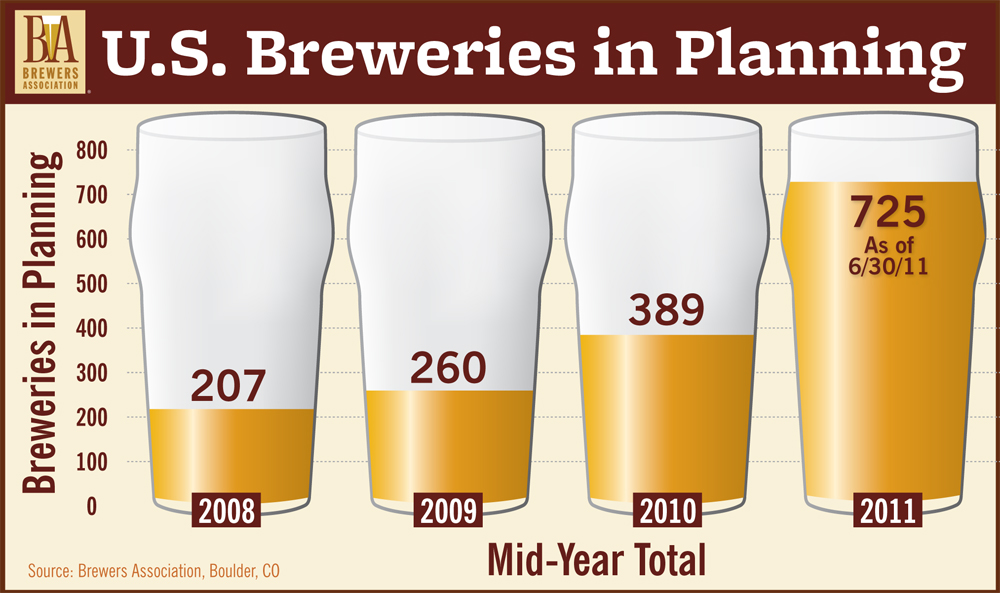
Don't get us wrong. Competition is always good for business. And the more craft the merrier is what we like to say. As long as someone is drinking quality over quantity we're on the right track. Right? Today I read a press release by the Brewer's Association (below) and found an alarming number of breweries being planned for production. What does this mean? Is this sustainable? Is this the beer equivalent of the yogurt craze in the 90's and now the similar craze with frozen yogurt and berries? Will be be doomed to the same fate as wine? Is it a fad? Will big beer die? Will craft come out on top?

Realistically there are only so many beer drinkers out there. You can get new drinkers simply with the coming of age. With craft it's more like growing up and enjoying a beer rather than getting plowed off of beer. You also loose them due to age, diet and other personal reasons. Craft has been converting people to purchase a quality 6 pack over a cheap 12 pack. Drinking beer instead of wine with a meal. But what happens if you have too many choices (gulp - did I really say that?).

For the off premiss side of things think of it this way. I always equate craft beer to dairy or specifically milk. Sure beer won't go bad as fast as milk but it does have a limited shelf life and limited shelf space. If you go to a c-store you see maybe 7 or 10 brands of milk (in urban areas) including Soy. But typically you see 4 at the most. Now milk is something a lot of people drink. Babies all the way to the Elderly. The age window for a beer drinker is arguable much smaller. They also drink a lot more and more often. But yet you don't see 155 types of milk at the store. What happens with you get too many beer options? Sure, the bad beer will get weeded out eventually but after causing how much damage? But what happens to the large craft players do they feel the pinch as the macro breweries do right now? What about the small regional craft breweries? What about all breweries? Does everyone simply throw away half of their product because it expires on the shelf due to too many options and product not moving?

The future looks to hold a lot of beer. Hopefully good, no - great beer. Until then we watch the growth with optimism and caution.

BA release below:

BREWERS ASSOCIATION REPORTS 2011 MID-YEAR GROWTH FOR U.S. CRAFT BREWERS

Brewers Association Reports 2011 Mid-Year Growth for U.S. Craft Brewers

Dollar growth up 15% in first six months of 2011; U.S. sees rapid growth in breweries in planning

Boulder, CO • August 8, 2011 - The Brewers Association, the trade association representing the majority of U.S. brewing companies, has released strong mid-year numbers for America's small and independent craft brewers¹. Dollar sales were up 15 percent in the first half of 2011, excluding brewers who left the craft segment in 2010². Volume of craft brewed beer sold grew 14 percent for the first six months in 2011, compared to 9 percent growth in the first half of 2010.

Barrels sold by craft brewers for the first half of the year are an estimated 5.1 million barrels. Despite many challenges, the mid-year numbers show signs of continued growth for craft breweries. The industry currently provides an estimated 100,000 jobs, contributing significantly to the U.S. economy.

"Craft brewers continue to innovate and brew beers of excellent quality," noted Paul Gatza, director of the Brewers Association. "America's beer drinkers are rapidly switching to craft because of the variety of flavors they are discovering. And they are connecting with small and independent craft brewers as companies they choose to support."

bip2011_final

Download a high resolution version of this graphic

The U.S. now boasts 1,790 breweries—an increase of 165 additional breweries since June 2010. The Brewers Association also tracks breweries in planning as an indicator of potential new entrants into the craft category, and lists 725 breweries in planning today compared to 389 a year ago. Additionally, the count of craft brewers was at 1,740 as of June 30, 2011.

"There is a growing interest in establishing new breweries," Gatza added. "It seems like every day we are hearing about a brewery in planning. Will they all make it? No, but many will if they produce high-quality, interesting craft beers and can get them to market through self-distribution and beer wholesalers and beer retailers."

¹ The definition of a craft brewer as stated by the Brewers Association: An American craft brewer is small, independent, and traditional. Small: Annual production of beer less than 6 million barrels. Beer production is attributed to a brewer according to the rules of alternating proprietorships. Flavored malt beverages are not considered beer for purposes of this definition. Independent: Less than 25% of the craft brewery is owned or controlled (or equivalent economic interest) by an alcoholic beverage industry member who is not themselves a craft brewer. Traditional: A brewer who has either an all malt flagship (the beer which represents the greatest volume among that brewers brands) or has at least 50% of its volume in either all malt beers or in beers which use adjuncts to enhance rather than lighten flavor.
2 Three former craft brewing companies left the segment in the second half of 2010 when transitions led them to no longer meet the Brewers Association's definition of independence.

Contact

Paul Gatza, Director
paul@brewersassociation.org, 303.447.0816 x122

Julia Herz, Craft Beer Program Director
julia@brewersassociation.org, 303.447.0816 x113

###

The Brewers Association is the not-for-profit trade association dedicated to small and independent American brewers, their craft beers and the community of brewing enthusiasts. The Brewers Association (BA) represents more than 70 percent of the brewing industry, and its members make more than 99 percent of the beer brewed in the U.S. The BA organizes events including the World Beer Cup®, Great American Beer Festival®, Craft Brewers Conference and BrewExpo America®, SAVOR: An American Craft Beer & Food Experience and American Craft Beer Week. The BA publishes The New Brewermagazine and its Brewers Publications division is the largest publisher of contemporary and relevant brewing literature for today's craft brewers and homebrewers.

Beer lovers are invited to learn more about the dynamic world of craft beer at CraftBeer.com and about homebrewing via the BA's American Homebrewers Association. Follow us on Twitter.

Friday, August 5, 2011

Beer 101 - The Bar: Drink Locally, Think Globally

As a consequence of the craft beer revolution, there is a vast choice of beer from abroad and closer to home. When confronted by a line of tap handles stretching the full length of the bar, do not overlook your local craft brewer. Independent local breweries are the backbone of any serious beer-drinking culture and should not be taken for granted in the competitive commercial environment. Recognize that a beer brewed in smaller quantities with 100% malted barley and high-quality hops will necessarily cost a little extra. Fresh, well-brewed beer that has traveled only a small number of miles will invariably taste better than an equivalent beer that left the brewery a few months ago. Indeed, a draft beer that has traveled a great distance will certainly have been pasteurized, thus is slightly handicapped from the start. The flip side to this is that a pasteurized imported keg of beer will certainly last longer when it is tapped than an unpasteurized, "live," craft beer. The latter needs to be drunk fresh. A conscientious draft bar should keep a few tap handles devoted to local craft brews and ensure that they remain fresh.

If a beer fails to live up to its obligation of being fresh, send it back over the bar-politely of course. Beer condition must always be the primary concern of any good bar. When confronted by a long line of tap handles, your first question to the bartender should be, "What’s fresh?"

Tuesday, August 2, 2011

Beer 101 - Can/Bottle Conditioning: Living Beer

The term "living beer" can be either high praise or a slap in the face for a brewer. If the things that are "living" in the beer are microorganisms that ought not to be there, then it is bad news for a beer and its brewer.

Live beer, however, generally refers to the presence of noble yeasts left over from the brewing process. Beers that have been bottled unpasteurized and unfiltered, with a significant amount of live yeast, are called "bottle-conditioned" beers. The purpose of bottling beers in such a manner is to give them the potential to age and develop more complexity. Yeast inhibits oxidation and contributes complex flavors as it breaks down slowly in the bottle. Many Belgian ales are traditionally bottle conditioned through a secondary fermentation in the bottle, in a process similar to that which produces champagne.

An unpasteurized beer bottled with its yeast will not age in the manner of a conventionally processed beer. With age, bottle-conditioned beers develop a rounded, smoother mouthfeel, and over the course of years, often take on winey, vinous flavors.

Bottle conditioning is an economical means for small-scale craft brewers to bottle ales without the need for costly pasteurization or filtration equipment. How long one cellars bottle-conditioned beers is a matter of personal taste and will also depend on the specific character of the beer in question.

The following is a list of some of the top-rated, cellarable, bottle-conditioned beers we have reviewed. All or any of these would be highly recommended for a beer cellar (e.g., a cool cupboard in the basement). Suggested cellaring periods are in brackets, though they are only approximate cellaring times based on personal experiences and in some cases, brewery recommendations. Three gueuzes have been included for the simple reason that these beers have the best cellaring potential in the beer world. Frank Boon of Brouwerij Boon claims a 30-year cellar life for his gueuze beers.

  • Brasserie d’Achouffe (Belgium) N’Ice Chouffe (up to 5 years)
  • Chimay (Belgium) Grand Reserve Blue (up to 5 years)
  • Sinebrychoff (Finland) Porter 1996 Bottling (up to 5 years)
  • King & Barnes (England) Millennium Ale (up to 10 years)
  • J.W. Lees (England) Harvest Ale 1998 (up to 10 Years)
  • Unibroue (Canada) Quelquechose (up to 10 years)
  • Young’s (England) Old Nick Barley Wine (up to 10 years)
  • Lindemans (Belgium) Gueuze Cuvée René (up to 15 years)
  • Frank Boon (Belgium) Gueuze Mariage Parfait (up to 20 years)
  • Cantillon (Belgium) Gueuze (up to 20 years)
  • Eldridge Pope (England) Thomas Hardy’s Ale (up to 20 years)

Monday, August 1, 2011

New Horizontal Lagering Tanks Are In


We spent the whole day unloading and positioning the 4 new 90bbl lagering tanks into place. They don't look that big in this picture but each one is about 10 feet tall just so you see the scale. The fermenters behind them are about 25ft tall.


Tuesday, July 26, 2011

We have an Erection!

The 60BBL Fermenters have been erected into place. So you can say we've got an erection. :D Oh yeah we do!


Monday, July 25, 2011

New Fermenters Arrive at Bohemian Brewery

Two new 60bbl fermenters arrive along with a 90bbl lagering tank from Specific Mechanical. We're giddy like a school kid in a candy store. Stay tuned.